Version 0.7
Since 7 November 2026, all fourteen volumes of the Sämmtliche Werke have been in the reader, newly obtained from the print and checked page by page against the scan. Here you can read what is new, how the text is produced, and what has been measured in it.
Screenshots at a width of 1,440 pixels in the dark theme. The figures come from the data of this version.
- volumes, checked page by page against the scan
014- printed pages, in the reader and as TEI
7,7627,881- reading errors in the electronic source corrected
- 8,931
- differing words on 26 independently read pages
- 0
- contents entries, aligned with the print
- 944
Before and after
Version 0.30 took over the text of an older electronic transcription, without matching it against the print. Version 0.7 is checked page by page against the scan. The same text in both versions, first in figures, then in individual passages.
In figures
| Version 0.30 | Version 0.7 | |
|---|---|---|
| Main text | following the electronic source | 82,680 words differ from 0.30, about every 28th word: misread words, lost syllables, shifted endings |
| Greek | 41,625 characters, garbled in 487 places | 58,350 characters, polytonic in Unicode |
| Notes | 3,018 collective blocks, all notes of a page in one, with no link to the text | 3,423 individual notes, each linked to its reference mark in the text |
| Citable | down to the page | down to the line: 250,747 counted printed lines |
| Tables of contents | 215 entries | 944 entries, aligned with the print, plus 388 marginal labels |
| Roman type (Antiqua) | not marked up | 6,425 passages set in roman type marked up |
| Printed pages | 7,762 | 7,881, with title pages and front matter |
In individual passages
- Only what the print has differently is corrected. Genuine misprints in the volume remain, even if the electronic source had silently smoothed them over.
- All passages have been decided against the scan; the examples can be checked in the Print layout at the page given.
Home page
The home page begins like the title page of a volume: Schelling’s name, the three rings, and the text on which the edition is based. Below are the volumes in a list and the key figures from the data.
The first screen · side by side
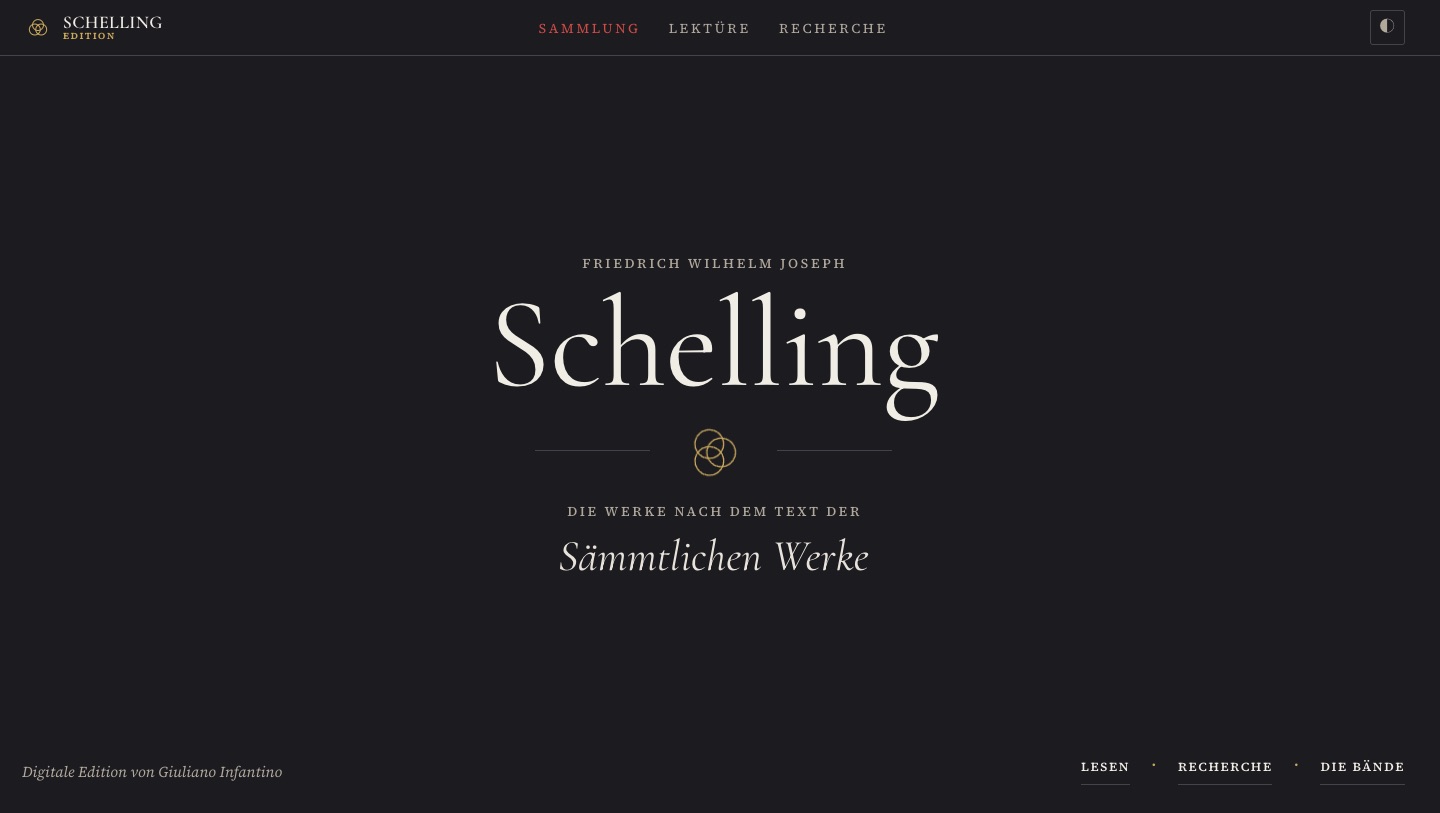
- Title page instead of promotional copy: in the middle, the name and what the text is based on.
- A list of the volumes, by the two divisions; each volume for reading and as a TEI file.
- Key figures from the data: volumes, pages, contents entries, and the version.
The text
The text is produced from three readings. An older electronic transcription supplies wording, letter-spaced type, notes, and Greek; to this is added the OCR of two copies of the print digitized by the Bavarian State Library. Where the three do not agree, the decision is made against the page image.
A check sheet: SW II/1, 456
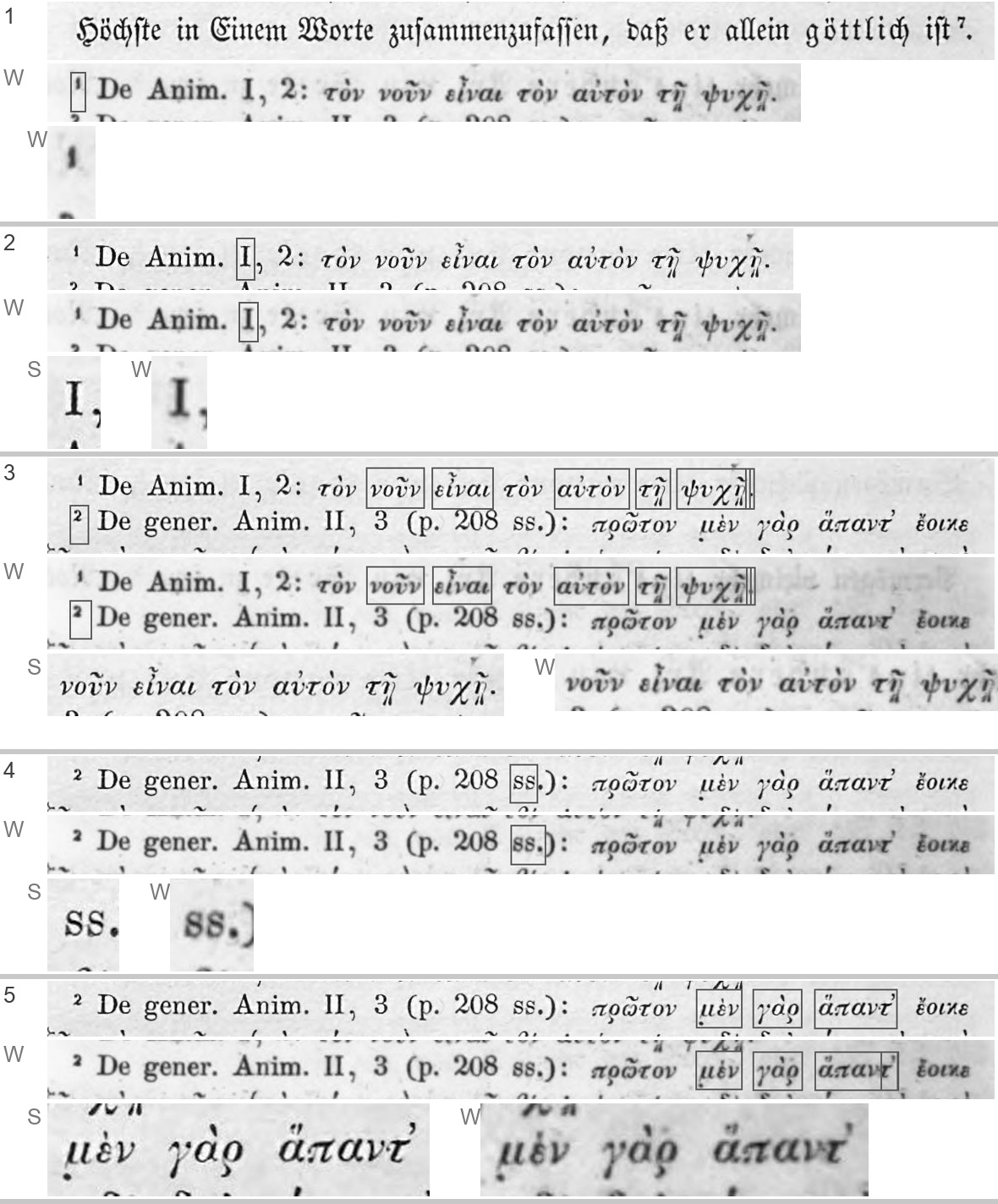
- A word is accepted without checking only if neither of the two OCR readings contradicts it and at least one confirms it. Everything else becomes a check point like this one: the line from both copies, and below it the passage enlarged.
- Decisions are made against the image, letter by letter and not by sense, by machine, with each page and its scan at once. Genuine misprints are retained.
- The whole page is read against the scan: even what none of the readings flags is corrected. Whatever cannot be settled conclusively goes into a second round.
Accuracy
Accuracy is measured against pages read outside the procedure and against errors inserted as a test.
What has been measured
- 26 pages of the Freedom essay (SW I/7) were read in full, independently. The text produced by the procedure agrees with them word for word and line for line: 7,822 words, 712 lines, including letter-spaced type and paragraphs.
- 40 plausible errors were inserted into pages as a test; the procedure found 38 of them.
- 8,931 improvements over the electronic source text, about one per page: misreadings, silent smoothings, garbled Greek.
- Why two copies: the second OCR reads genuine misprints literally where the first smooths them over (verstanten, siunliche). In a test, a weaker OCR would have missed 7 of 43 genuine errors; this is why both readings come from the library.
- Still open are three pages not yet decided against the scan: SW I/3, 153; I/4, 295; I/10, 197.
Reading
The reader shows every volume in two views: as a flowing reading text and as a print layout, line for line as in the volume of 1856–1861.
Print layout: SW II/1, 456
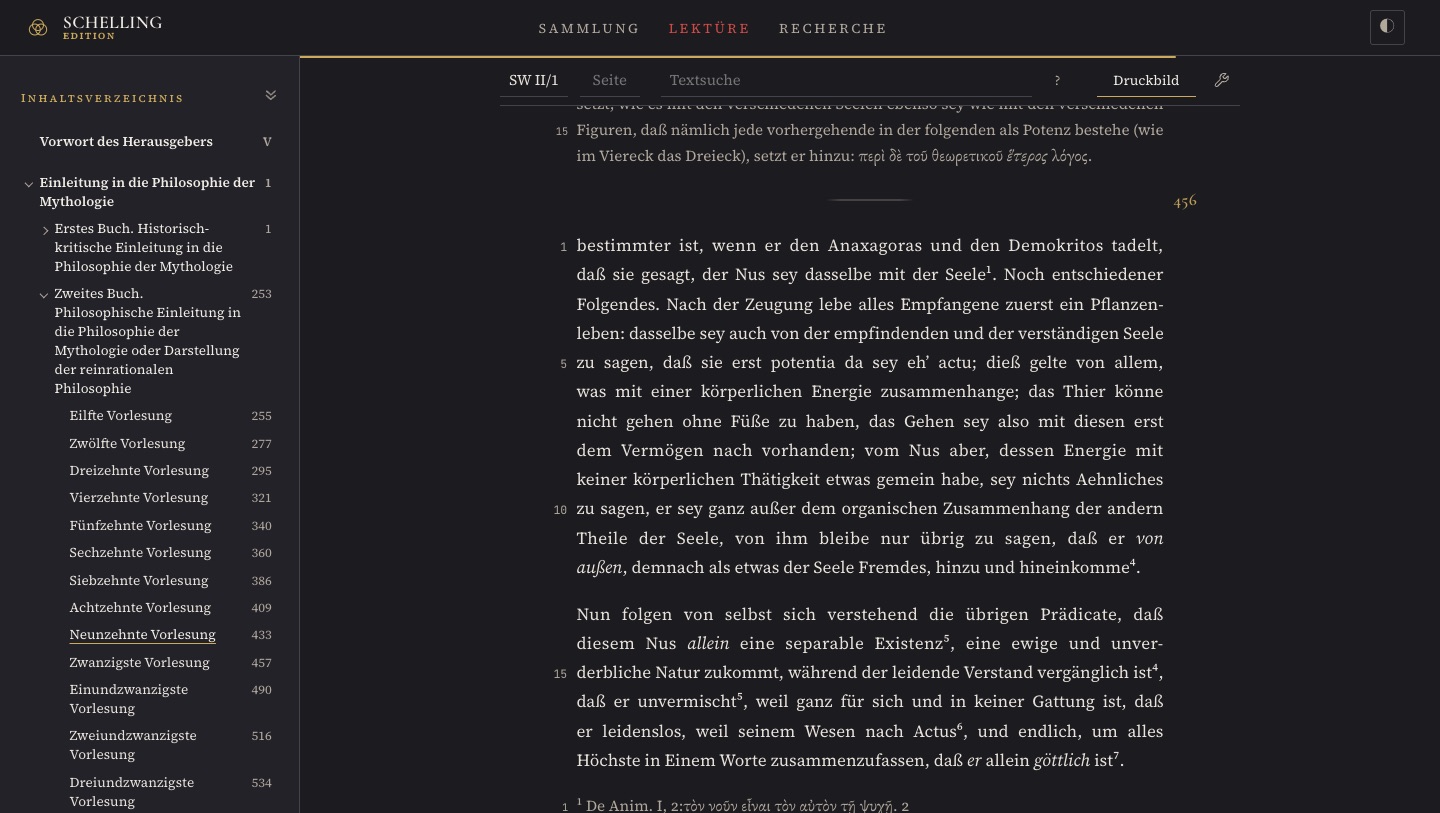
- Lines as in the print, numbered in the margin: citations down to the line (SW II/1, 456.12).
- Notes in their place, Greek in polytonic Unicode, letter-spaced type marked, words set in roman type (Antiqua) recognizable.
Contents and marginal labels
The tables of contents follow the printed ones. Many items of the printed synopses have no heading in the text; the print gives only the page. This edition gives the paragraph.
Synopsis item with marginal label: SW I/6, 219
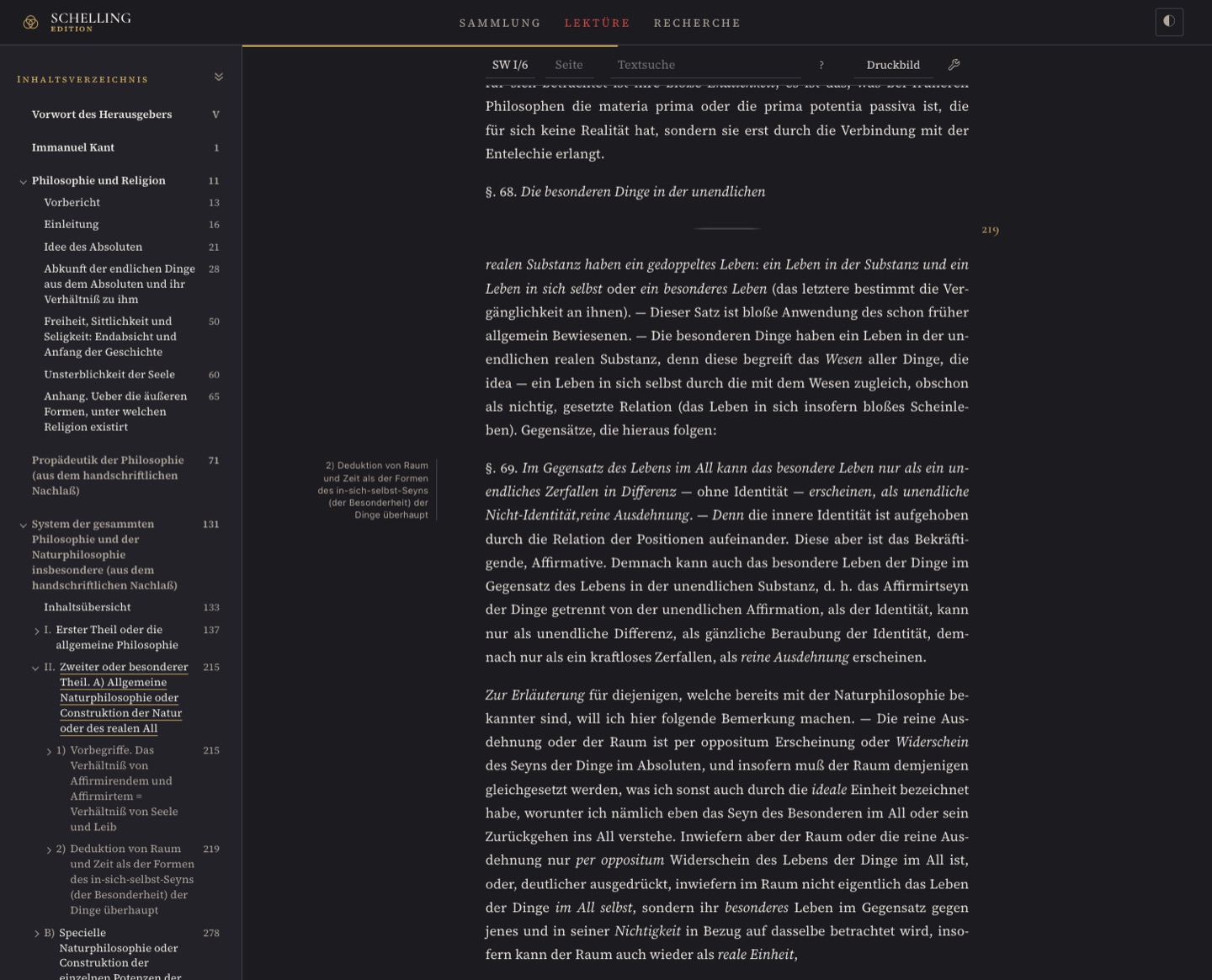
- 944 entries, aligned with the printed table of contents and the headings of the text.
- 388 synopsis items without a heading in the text jump to the paragraph where their subject begins; their title stands there as a marginal label.
- The marginal label is an addition of this edition: small, gray, in the margin. In the contents such items appear more quietly than real headings.
Verses, mottos, formulas
What the print sets off in the center is not always a heading. Verses, mottos, inscriptions, and formulas now appear as quotations within the running text.
A motto in the text: SW I/6, 15
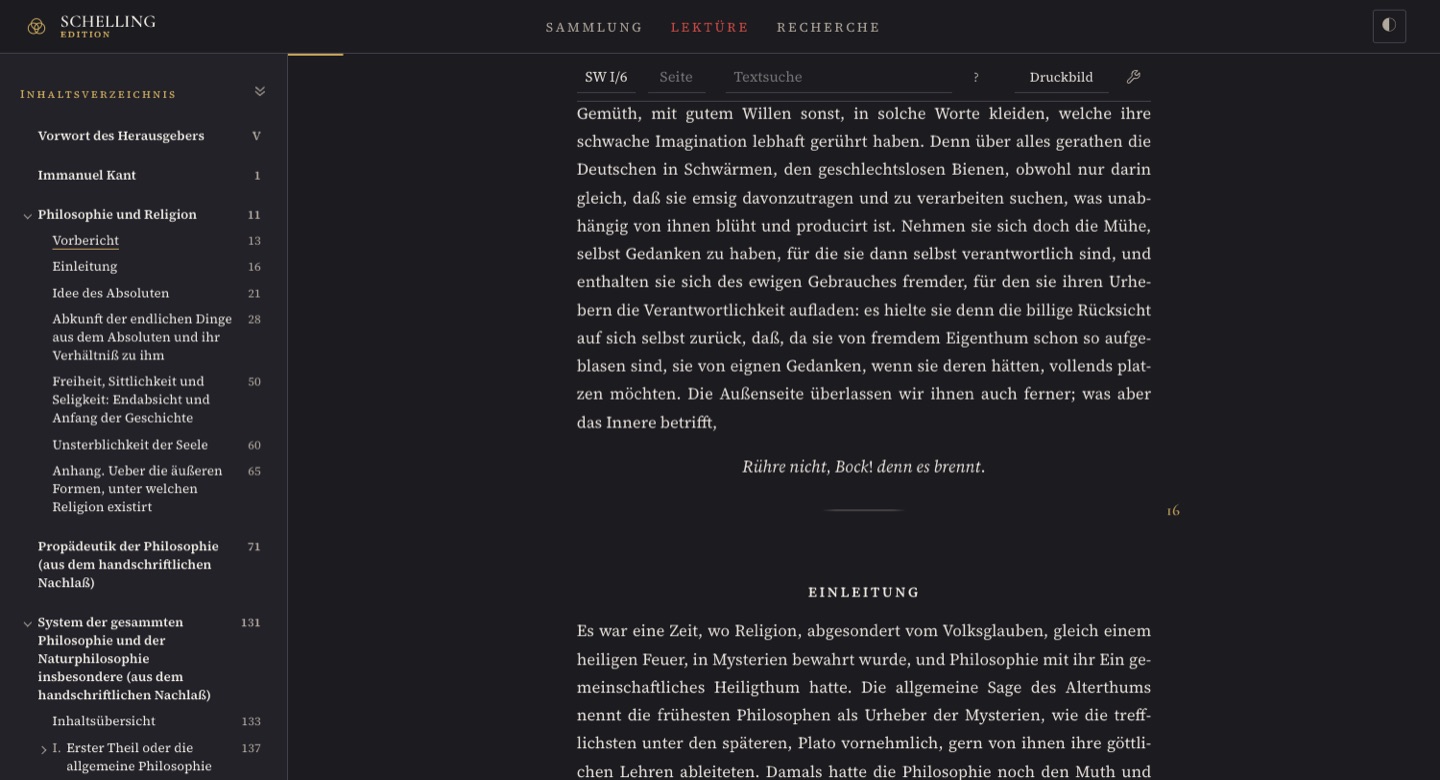
- 122 passages across all volumes, from mottos to Greek verse.
- The contents stay clean: what is not part of the structure no longer intrudes as a heading.
Search
Full-text search covers all fourteen volumes and cites every passage down to the printed line.
Search for “Mythologie”
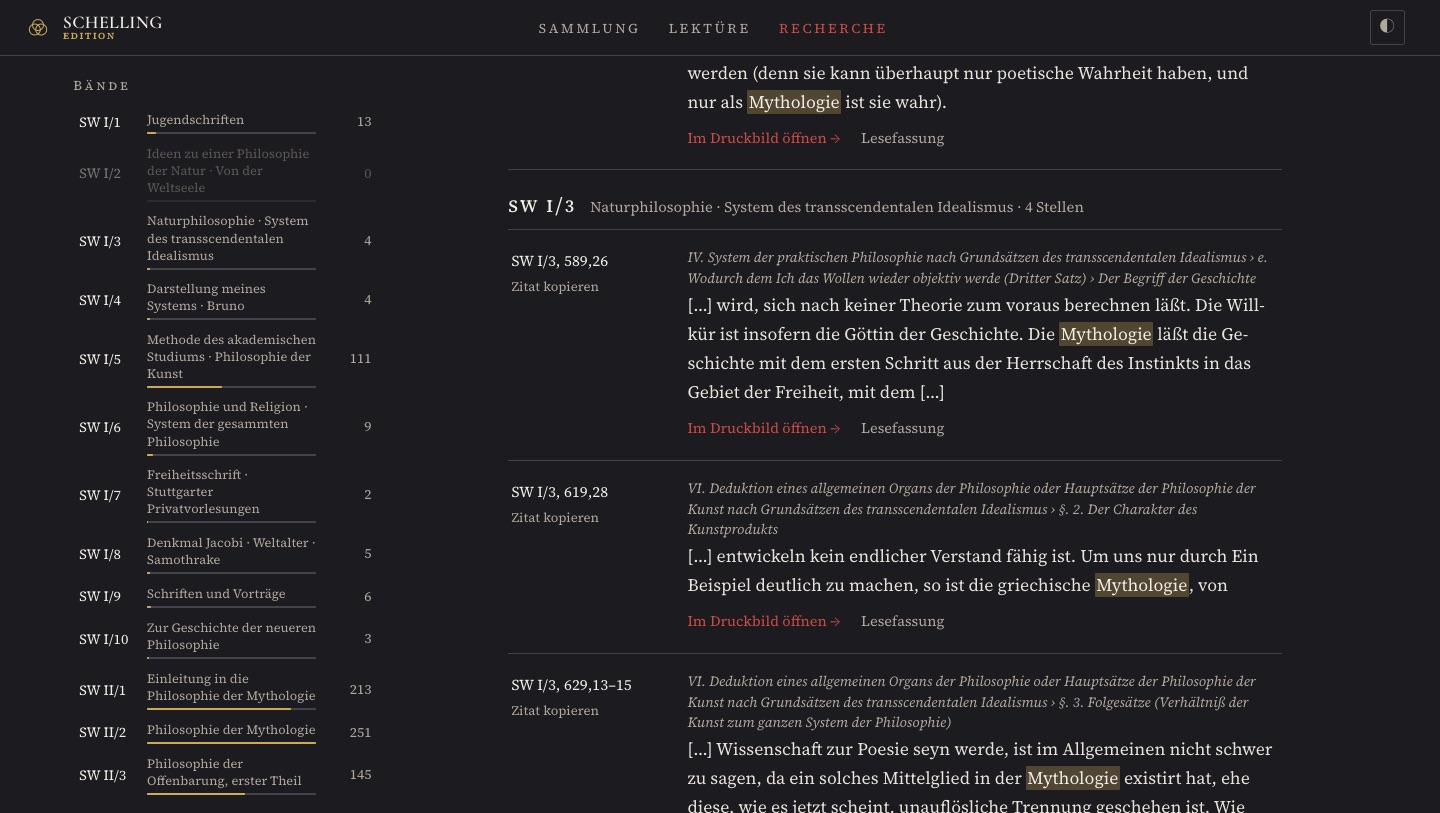
- Citation down to the line (SW I/3, 589.26), with the section in which the passage occurs.
- Hits per volume, and one click opens the print layout at exactly that passage.
Open data
Every volume is available as a TEI file (P5), the same data from which the reader builds its pages; the round-trip test is identical for all fourteen volumes. The text is in the public domain; the data are licensed under CC BY 4.0 (Reuse, Guidelines). The files are listed with each volume on the home page.